
DWB Notes: Three Economic Thoughts on my Mind in 2026

We are nearing two weeks into the 2026 calendar year. My head is spinning in the new year, but I've been anxiously awaiting the new episode of Industry, which came out last night on HBO. In order to prepare for the new season, I've been thinking a lot about the economy and what we can all expect in 2026.
Nobody asked my opinion (and why would you?), but I'm dedicating my newest blog post to three trends I want to watch in the new calendar year. Hope everyone had a great holiday season, and I hope you enjoy my thoughts in the new year.
The simple price is dead.
I’m sure you’ve noticed this, too, in ways both slight and significant. Prices are not just rising (though they are rising); they are also changing. What used to be a flat fee is now a subscription service. What we once saw as an all-inclusive price is bundled with fees and taxes. The fixed price of 2021 is now the dynamic price of 2026.
I find myself more interested in the "why." Why is the simple price dying? Or dead? Let's address that.
Commentators I’ve read like to suggest the “why” has to do with corporate greed. I’m not as convinced; I actually think the explanation is both more nuanced and more significant.
In my view, inflation is the primary driver. As prices rise in an economy more generally, competition to “win” business becomes more difficult.
Think about this: it does not take a PhD in economics to demonstrate that as real prices increase, consumers must ration their disposable income. It's just common sense. If the cost of all your streaming services increases, for example, one might have to drop HBO Max (not for nothing: that one should be the last to go; who doesn’t love Industry). People might use different frameworks to make decisions about which to drop. I’d place arbitrary value to each one, compare that value to its price, and drop the lowest one (Peacock).
So how does a company win business when consumers spend less? They change the structure. Here are a few ways of doing that:
Once you've decided you want to buy the item based on the sticker price, they bet you'll just finish your transaction, ignoring the additional 20% of added-on fees. Looking at you, Ticketmaster (they've recently changed this practice.).
We’re also seeing more subscription services enter the market. This is less about inflation and more about how investors analyze earnings and company value. Earnings before interest, taxes, depreciation and amortization — otherwise known as EBITDA — used to be a significant KPI for investors to judge performance of a company. I’m sure that metric is still relevant, but there are two I’ve seen trending recently that seem to be outdoing EBITDA: monthly recurring revenue (MRR) and annual recurring revenue (ARR). Recurring revenue is more steady and therefore helps increase the value of companies.
The effect of that? Adobe’s Creative Cloud suite is now only a subscription model, as is the Microsoft Office suite. You no longer buy music; you pay a subscription to listen to anything you want. Some software features in cars are even moving to a recurring revenue model. The “one-time payment” is probably done for software entirely, services mostly, and physical products soon (looking at you, BMW heated seats. That plan was discontinued in 2023...for now.).
The fight against credit card debt is alive
This might be the most interesting fight in 2026. President Trump recently announced a goal of capping credit card interest rates at 10%. I predict this will be a major storyline in this new year, so much so that I think it will earn a mention in the upcoming State of the Union address the president will give in February.
There is so much about this policy proposal that I find interesting. My principal thought is what I call the “Romney Question.” I transport myself back to 2012 and think about President Obama’s campaign against former Massachusetts Governor Mitt Romney. I ask myself: “Can you imagine Mitt Romney doing this?”
As an aside: This is the thesis of my next section, so I’ll only give a limited preview: the modern GOP has shifted so much in its policies that it’s now beyond conservatism. The position of capping credit card debt seems, to me, to be more of a liberal position than a conservative one. It’s usually the Democrats you hear complaining about big banks trolling on the personal debt issues of “everyday Americans.” Nevertheless, here we are. Moving on.
Here's another interesting point: Republicans widely denounced President Biden's order to forgive student loans. Nevertheless, they are suddenly very interested in this policy, despite student loans bearing remarkable similarities to credit card debt. Here are a few notable similarities:
Credit card interest rates are variable and sit between 20-30%. Student loans vary wildly, with federal loans sitting between 6-10% and private loans reaching up to 20% in some circumstances.
Here's one notable difference between credit card debt and student loan debt—and it makes student loan debt substantially more dangerous: Credit card debt can generally be discharged in a bankruptcy. Student loans cannot. They are presumptively non-dischargeable loans absent a borrower showing some form of undue hardship. Good luck beating that high legal standard.
When Republicans opposed the student loan forgiveness program, they generally took the position that borrowers should take responsibility for their financial decisions. I agree! Want to know who else should take responsibility for their financial decisions? Credit card holders. I want to make clear that I am not charging the Republicans with hypocrisy. President Trump is talking about capping rates of interest, not outright loan forgiveness. Those are different policies, and we should split that hair. Nevertheless, it is a fascinating situation.
For what it's worth: I oppose both student loan forgiveness and capping the rate of interest for credit cards. There are two primary consequences of this policy (one can argue whether they are good or bad):
I tend to think that getting a credit card for the purpose of rewards is — ceteris paribus — a bad idea. Nevertheless, it is a nice benefit to have. I do recognize these rewards may be a net negative for society. There is no question that Americans spend more on credit cards due to these rewards (I even find myself turning away from any cash in my wallet to use my credit card because I know about that 3% back at restaurants; whether I spend more when I use my credit card is unclear).
What is clear to me is that these rewards are virtually only possible due to some people taking on enormous debt loads they cannot afford. That mimics a zero-sum game that concerns me (think: in this case, for me to profit and the bank to profit, someone has to lose money).
If an interest cap goes into effect, these rewards programs likely get scaled back—potentially dramatically.
Economic populism seems set to transcend political barriers
I’ve been talking about this for quite some time. I started paying attention to politics in the midst of the 2010 midterm elections (I was eight. I was an insufferable child). In those days, it seemed more obvious to me that the Republicans promoted economic conservatism and the Democrats promoted economic liberalism. Democrats widely wanted to raise taxes on the highest earners; Republicans generally opposed tax increases. Democrats did not universally believe in trade protectionism, but there was surely a pro-America labor stance among some elected officials; the GOP, on the other hand, seemed less likely to wield a tariff. Republicans were content with a capital gains tax rate that sat lower than the tax rate on earned income; many Democrats excoriated those policies. Remember that video of President George W. Bush talking about immigration and expressing concern about the evil triplets of "isolationism, protectionism, and nativism?" Can you imagine a Republican saying that today on national television? Heck no.
My new view is that populism — particularly economic populism — is creating a political realignment. There is a large group of voters (and a Wikipedia page) who voted for President Obama twice and President Trump three times. Who are these voters? They are overwhelmingly classified as "white voters without a college degree." The New York Times reported in 2017 that Secretary Hillary Clinton won “just 78 percent of white Obama voters without a bachelor’s degree.” That number would decrease for Biden and then again for Harris.
Why is this? Analysts disagree. Some believe it is about immigration, others about race, and others the economy. They could all be right or all be wrong. To be honest, I don’t care (at least for the purposes of this post). What I do care about is this key finding: “Republicans in particular can dramatically improve their chances by increasing their vote share among ‘Populist’ voters — people who have liberal economic views and conservative social views.”
I also find interesting that, in 2016, the largest group of swing voters in the electorate came from people that a survey identified as socially conservative and fiscally liberal. Check out this graph from the Voter Study Group's post-2016 report.
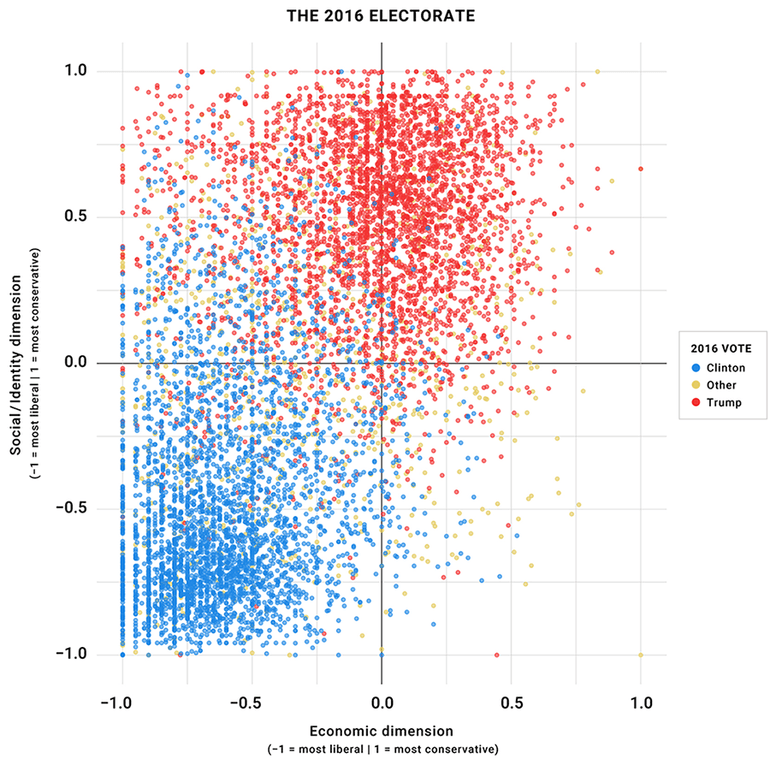
Swing voters in the 2016 election by fiscal/social issues. (Source: Voter Study Group)
In that report, the authors predict that “Trump’s biggest enthusiasts within the party are Republicans who hold the most anti-immigration and anti-Muslim views, demonstrate the most racial resentment, and are most likely to view Social Security and Medicare as important.” The philosophy can be described as "Dear federal government, get immigrants out of my country and the tax revenue into my pocket. Please and thank you."
What does this get us? You get President Trump floating the idea of raising taxes on the wealthy. Back to that whole “Romney Question” thing: no way that happens in 2012. Conservatives have always been in favor of tax cuts, but a tax cut only for tipped wages? That’s new.
The most interesting symptom of this new reality might be Missouri Senator Josh Hawley (R). Let's look at a few of his general feelings on economic issues:
-
Increase tax deductions for working-class, lower-income Americans. In fact, when he announced his support for this, who did he criticize? Mitt Romney! He said this: "Yet two-thirds of Americans pay more in payroll taxes than they do in income taxes. And most working-class Americans pay little or no income tax at all. That doesn't mean they are freeloading. Mitt Romney's infamous barb about "the 47 percent" who allegedly pay no taxes was never accurate."
-
Raise the minimum wage. This also includes a "blue-collar bonus tax credit."
-
Change the tax rates of capital relative to labor, prioritizing labor.
All of that sounds like a Democratic Party dream. So why isn't it? Because Josh Hawley also holds the following social views:
-
Supports the construction of a border wall on the southern border of the United States.
-
Supports the Trump Administration's family separation policy.
That is the prime example of economic populism and social conservatism melding together.
In conclusion: prices are weird, debt got loud, and politics got strange. I'm sure that only my mom made it this far. There is no subscription required to read my blog, but if you'd like the ad-free version, please Venmo me exactly one (1) Dove bar's worth of shrinkflated soap. Just kidding.
See you next time.